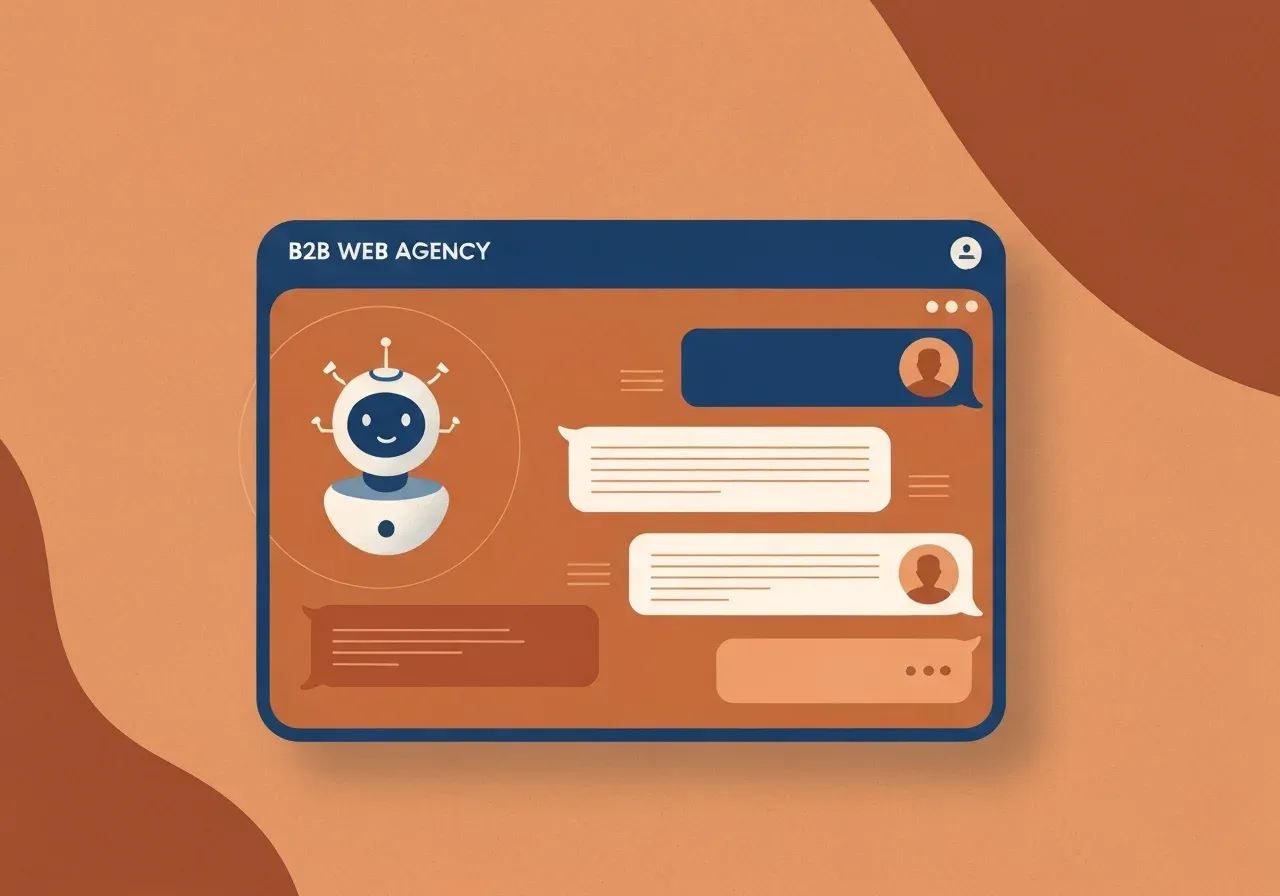
Most “AI solutions” for customer service are the same widget with a different logo. We have integrated chatbots for clients as part of their business logic, so here is where it works, where it stops and what to measure.
What a chatbot does well
A chatbot grounded in your company’s own data handles three jobs reliably.
Answers to frequent questions. Prices, delivery times, opening hours, return conditions. The bot answers them quickly, identically for everyone, at any hour.
Qualifying enquiries. The bot finds out what the person needs, the rough budget and the timing, so the manager gets a customer with context.
Taking bookings. For salons, clinics and car services, the bot books inside the conversation, with no form.
Where it fails
- Complex advice. A bot can collect details, but a choice between complex services with dozens of variables belongs to a person.
- Emotional situations. Complaints and conflicts get worse with an automatic reply. We always configure a clear route to a real person.
- Edge cases. A bot trained on your data handles typical requests well. An unusual question outside that data gives a poor answer. This is a fundamental limit, not a bug that will be “fixed later”.
Three scenarios where the return is easy to measure
- Online shop, support load. The bot takes order status and delivery questions; the team handles the rest.
- B2B services, lead qualification. Only enquiries that fit the target customer reach the manager.
- Appointment-based services. A customer books at 11 PM and the manager sees a filled schedule in the morning.
We give no percentages on purpose: the result depends on your question mix.
How we integrate it
- Connected to your real data: product catalogue, price list, booking calendar, FAQ base. When the data changes, the bot reflects it, with no manual updates.
- Escalation is built in from day one. The system knows when to decline and when to hand over to a person. Wrong escalation is one of the main reasons chatbots damage customer experience.
- Tested on real scenarios, not demo data, before launch.
- Languages are set up separately. Latvian and English each need their own configuration and testing.
If you handle phone calls rather than web chat, see our article on an AI phone assistant as an alternative to a call centre.
What to measure
- Resolution without a person: the share of questions closed by the bot alone
- Escalation rate: the share of conversations passed to a manager
- Conversion from chat: how many people who started a chat completed the target action
- Answer accuracy: a review cycle every month
Measuring starts on day one. Without it you cannot tell whether the bot pays off.
When not to build one
We do not recommend a chatbot for a company with no clear goal and nobody who will watch the metrics after launch. An unsupervised tool becomes a problem, not a solution. If personal data passes through the bot, also agree early on where it is processed and stored; for EU customers that is a GDPR question, not an afterthought.
Next step
In a 30-minute call we can walk through your scenario, show how the system works with real data and tell you whether it fits at all. See the AI automation service or discuss your project.