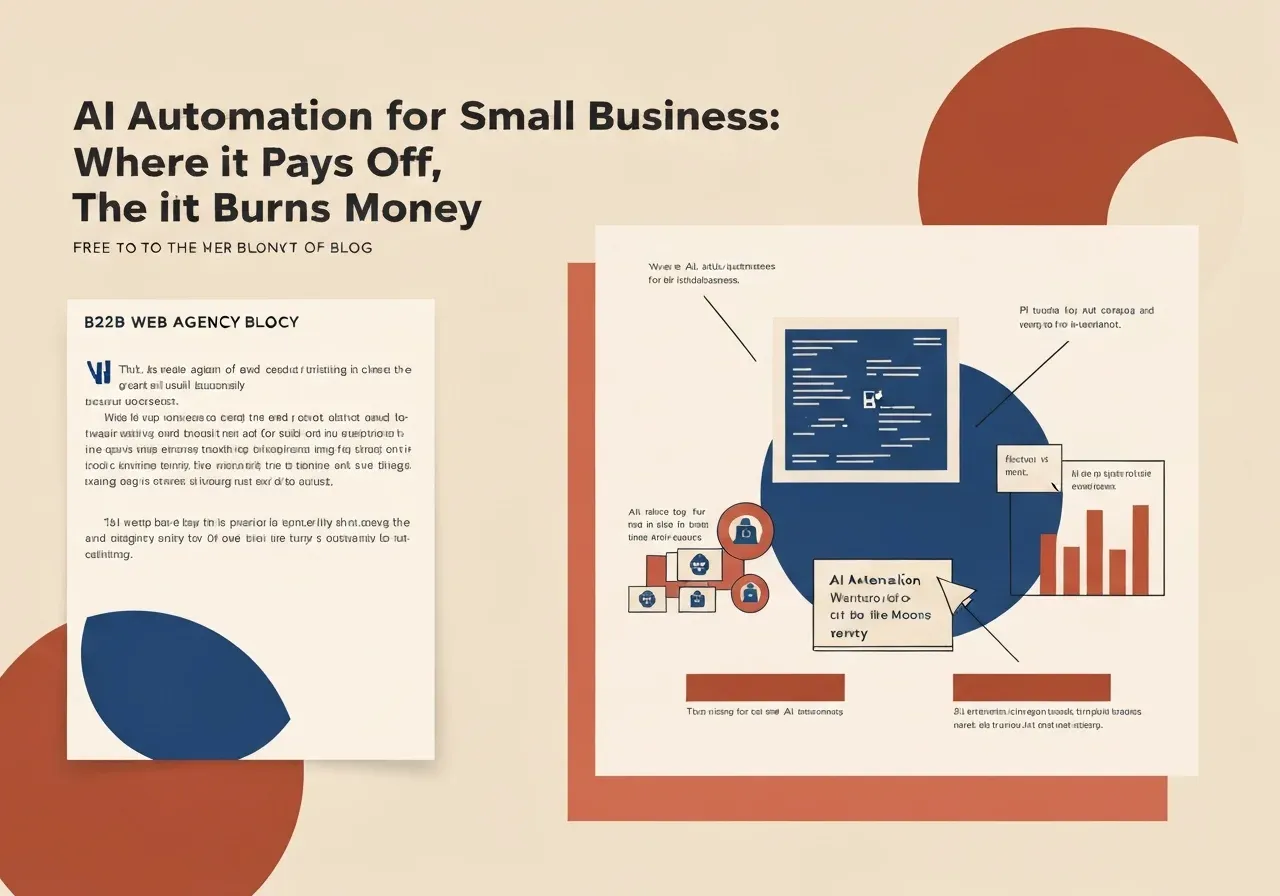
AI automation can save a small company time, or become an experiment with no end. The difference is rarely the technology. It is whether the work being automated is clearly defined and repeats.
Eurostat data show that in 2025, 17% of small EU enterprises used AI, against 55.03% of large ones (Eurostat). Small companies have few ready-made examples, so the choice has to be deliberate. Here are the criteria for telling the two apart.
Where AI usually pays back for a small company
AI works best on tasks with many repeated but slightly different inputs, where a mistake can be corrected:
- Incoming emails and enquiries. Sorting by topic and urgency, drafting replies that a person approves.
- Phone calls. Answering outside working hours, booking, or passing a message to the right person. See the AI phone assistant article.
- Documents and invoices. Reading data from PDFs or scans and passing it to accounting with a check.
- Repeated questions. A chatbot built on your own content, not generic answers. Results in our chatbot article.
What they share: the process is clear, the result can be checked, and when AI errs, a person notices.
Where AI burns the budget
- The process is not in order. AI automates chaos faster. If you do not know how an enquiry is handled now, automation will not find out.
- No clear result. “Introduce AI” is not a goal. “Reply to an enquiry within an hour” or “enter invoices without retyping” is.
- A mistake costs more than the saving. If one error costs more than ten correct runs save, do not leave it to AI without human review.
- Data is not organised. If knowledge is scattered across spreadsheets and heads, a chatbot only answers what it knows.
- The tool is chosen before the task. The most common reason a first project fails.
Data, GDPR and the AI Act
Before giving customer data to an external AI service, find out where it is processed, whether it is used to train models and whether there is a data processing agreement. Our approach is to offer solutions where data stays in the EU and a person approves the important actions. We assess specific providers and models with you at the start of a project.
The European Commission states that the AI Act entered into force on 1 August 2024, prohibited practices and AI literacy obligations apply from 2 February 2025, and general application starts on 2 August 2026; this includes a duty to tell people they are dealing with a machine, such as a chatbot (European Commission). In practice: if a customer talks to an AI assistant, say so clearly. Also check that your use case does not fall into a high-risk category.
How to start without overspending
- Pick one job that repeats weekly and takes real time.
- Write down the current process and how long it takes.
- Define a checkable result: time, error count, reply speed.
- Run a small pilot with human review of every result.
- Compare before and after, and only then decide whether to extend.
If the result after the pilot cannot be measured, that is reason enough to stop.
Ready-made product or custom
For a standard task a ready-made product is faster and cheaper. Ours are FDesk for processing incoming enquiries and emails, and DeskVoice for a phone assistant. Custom automation is justified when the process is specific or several systems must be connected; then we build it around your data and integrations.
Decision rule
- Work repeats, rules are clear and the result can be checked: AI is worth trying.
- Process not in order: fix it first.
- A mistake is expensive or data must not leave the EU: plan human review and EU processing from the start.
- You cannot name the result you will measure: do not start.
To assess where AI could help in your company, see our AI automation solutions. Discuss an AI project.