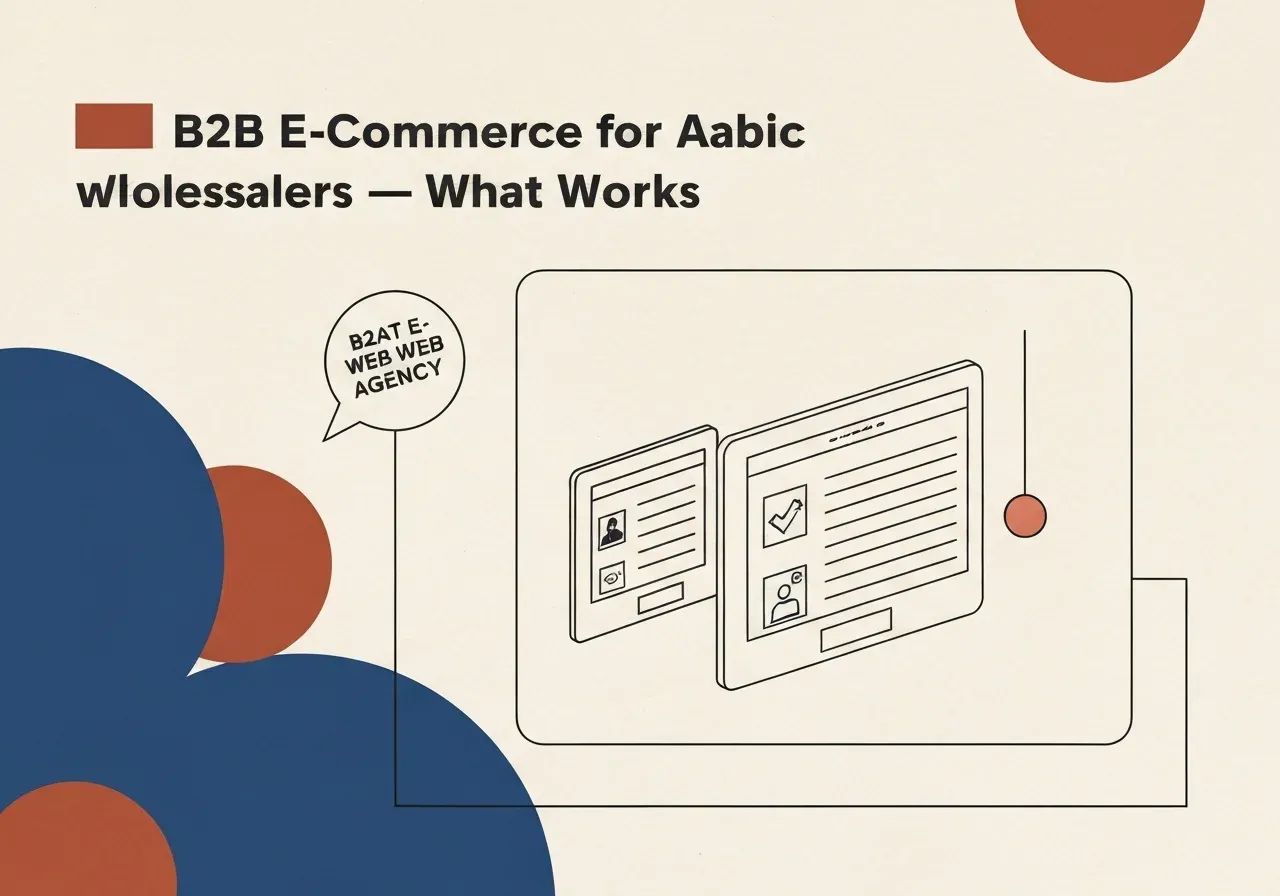
If you run a wholesale company and are thinking about “an online shop”, one thing needs clarifying first: what works for B2C does not work for B2B.
A B2C buyer arrives, picks a product, pays by card and leaves, and everyone pays the same price. B2B is different. You may have 200 customers, each with their own price list. One buys at 15% below list, another has a credit limit of €50,000, a third may order only certain product groups. That is not a shop. It is a work portal, which is why standard e-commerce platforms often do not fit.
What a wholesaler needs from the platform
Requirements vary by industry, but the core repeats:
- Customer-specific prices. Not a discount code or a “premium tier”, but a price matrix per customer or customer group. It usually lives in 1C or the ERP, and the portal must receive it in real time.
- Minimum order quantities (MOQ). You cannot sell one piece wholesale. The portal must know that this item is sold only in packs of 12, and that one requires a minimum order value.
- Credit limits and payment terms. Most wholesale customers buy on deferred terms of 30, 60 or 90 days. The portal should show how much of the limit is used and how much remains.
- A document flow. Customers expect to download invoices, delivery notes and return documents themselves, at any time, instead of e-mailing for them.
- Real-time stock. Not “usually in stock” but an exact quantity today.
Why Shopify and WooCommerce often fall short in serious B2B
They are good products, and we use them for B2C and for small B2B with simple logic. Problems start when the company needs more:
- Price logic. Shopify offers price groups, but not individual customer prices synchronised from an external system. Every time prices change in 1C, someone updates the platform by hand.
- Credit limits. A standard platform does not handle them. A credit limit is business logic that lives in your accounting system, not on the payment gateway side.
- ERP integration. Platform APIs are not designed to read live data from your ERP with all its business logic. Companies end up with fragile connectors that break on every update.
For a wider comparison, see WooCommerce, Shopify or custom development.
What a sound B2B portal looks like
When a company comes with serious B2B requirements, we build:
- A customer portal. Each customer logs in and sees only their own prices, order history, credit limit and documents.
- A catalogue with filter logic. Each customer can see a different product range.
- Order management. The portal validates an order against MOQ, credit limit and availability before sending it to the ERP.
- A document centre. Invoices, delivery notes and credit notes appear as soon as the ERP generates them.
- An admin panel. Your team manages customer rights, price groups and limits without a developer.
More on our e-commerce services.
Integration with 1C, ERP and accounting
The main integration steps:
- Product sync. Prices and quantities are updated in the portal in real time or with minimal delay.
- Customer data sync. Credit limits and payment terms live in the ERP, and the portal must receive them.
- Order handover. An order placed in the portal is written to the ERP automatically as a new document.
- Document generation. Invoices and delivery notes are created in the ERP and appear in the portal without manual upload.
1C integration needs a clear API or database interface. Newer 1C versions support REST, which helps. Before a project we always check what the specific 1C version can and cannot do. What typically goes wrong is covered in our guide to 1C integration for websites.
Start with the problem, not the platform
Before choosing a technical solution, find where you lose the most today. Is it your sales team’s time? Errors in order processing? Difficulty seeing a customer’s history? The architecture follows from that, not the other way round.
If you are a wholesaler considering a B2B portal, discuss a B2B e-commerce project with us.