A few years ago a clothing manufacturer from Riga came to us. They had a working Shopify store with about 400 products, and one problem: whenever prices had to be adjusted for a particular customer, someone spent an hour on manual work. They sold wholesale, with prices depending on customer status, and Shopify does not support that without expensive add-ons. They moved to WooCommerce with a custom pricing module. It worked, but only because we first understood the real constraint.
That is typical. A platform is neither good nor bad; it fits a case or it does not. This article is about how to find out which.
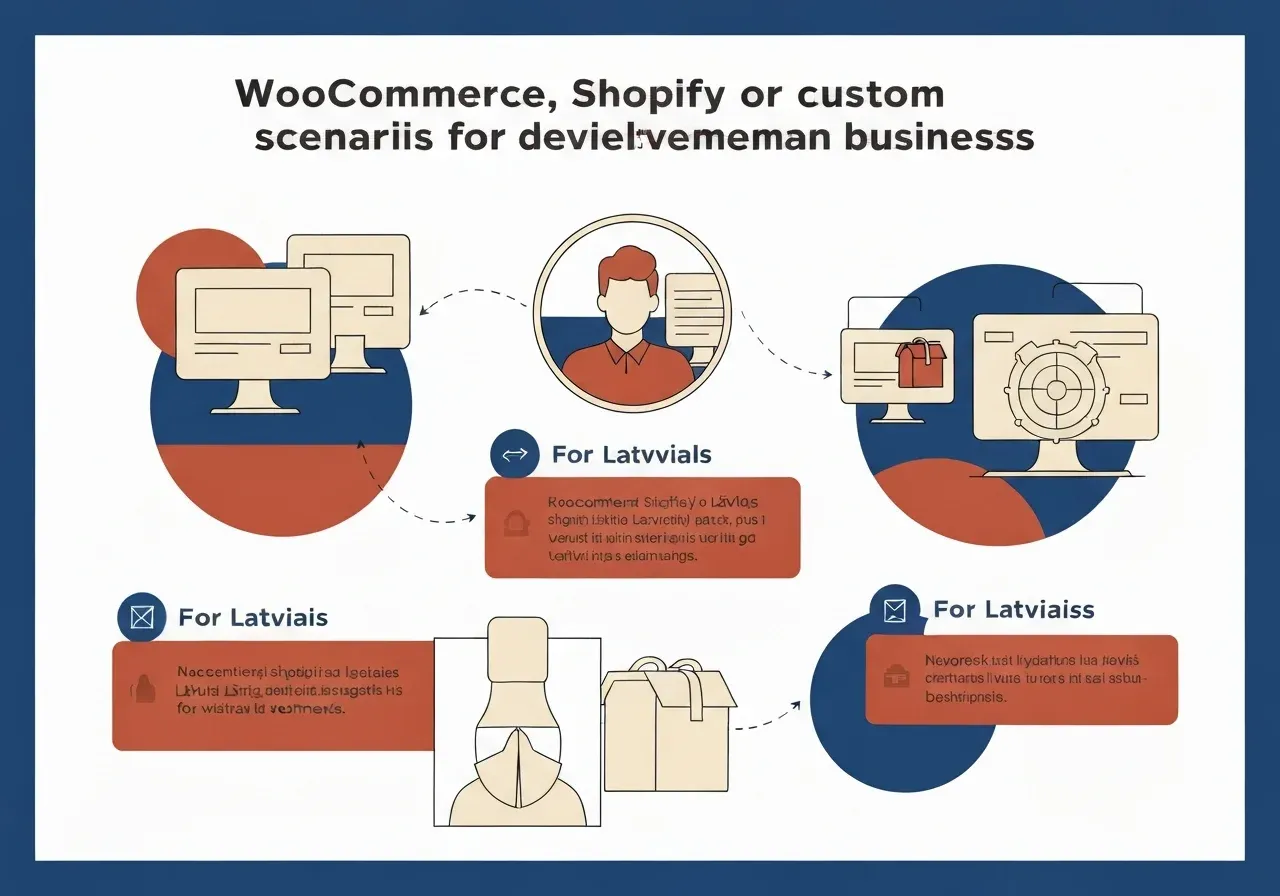
Shopify: when it works and when it complicates things
Shopify is a good choice if you have a simple catalogue, sell mostly B2C and do not want to think about infrastructure. Hosting, security updates and the SSL certificate are included in the monthly fee.
The simple part ends there. Wholesale prices that differ by customer group need third-party apps or a higher plan (Shopify Plus). Integration with accounting systems used in the Baltics, such as Jumis, Horizon or 1C, is not standard and has to be built separately. Checkout customisation is limited because Shopify protects its payment flow.
If your logic is non-standard, with products that have many variants, bundles or sales on account, you reach the platform’s limits quickly. We often see companies start on Shopify because it is fast, and return two years later with a list: this does not work, that cannot be changed, this add-on costs €80 a month and does not do exactly what we need. The system is not bad. It just does not fit the case.
WooCommerce: freedom with conditions
WooCommerce is an open-source plugin for WordPress. In theory you can do almost anything; in practice you are responsible for everything, yourself or with a developer.
It fits well when you already have a WordPress site, when your product logic is complex (customer-specific prices, discounts, subscriptions, bundles), or when you need integration with 1C, Moneo or another local system, where it is more open than Shopify.
It also has drawbacks that get less attention. Plugin updates sometimes break things, especially after years of accumulation. As you add functions the system gets heavier and harder to maintain. Cheap hosting shows in speed and stability. That is not the platform’s fault; it is the price of flexibility.
WooCommerce is like owning a house, and Shopify like renting a flat with a building manager. In the house you can rebuild anything; in the flat you do not deal with maintenance, but changing something fundamental is hard.
When neither fits
Sometimes requirements cannot be met by Shopify or WooCommerce without heavy customisation. Then we talk about a custom e-commerce build.
An example from our practice: a client makes and sells metal structures. The buyer must configure the product online (size, colour, extras) and get an instant price from a complex formula. The order has to reach the production system automatically, with no manual copying. No ready-made tool supports this out of the box, so we built it on Laravel. It took several months, and the client now saves hours every day and avoids copying errors.
Custom development is justified when:
- your business logic is so specific that no platform supports it, even with add-ons
- you have serious integration requirements with ERP, CRM or production systems
- you plan volumes where standard platforms’ performance becomes a constraint
- over time, the custom system will cost less than accumulated licences, add-ons and workarounds
The regional context that platform comparisons skip
Most comparisons are written with the US or Western Europe in mind. Several things deserve separate thought in the Baltics and the Nordics:
- Payments. Stripe and PayPal work on both platforms. But many Baltic customers want to pay through their internet bank, and both platforms support that through extra integrations that work differently and are not always free. If your target customer is local, the payment experience is a hard requirement, not a detail.
- Invoices and VAT. If you sell to other EU countries, VAT logic gets complicated. WooCommerce with the right plugins handles it well. Shopify suits simple cases, but a more complex one needs extra tools. We have seen companies send invoices by hand because the PDF exported from the platform did not meet local accounting requirements.
- Languages. Customers expect the shop in their language. Both platforms support translation, but it is real work, and not all plugins are fully localised. A custom system can do it exactly as needed.
- Local systems. Many Baltic companies use 1C, Moneo or Jumis for accounting. Integration needs separate work on any platform, and in our experience that is often where most of the effort hides.
How we approach the choice
When a client says “we need a shop”, we do not ask “which platform do you want?”. We ask: how many products do you have and how complex are their variants? What is the sales logic, B2C, B2B or both? Which systems must be integrated? What traffic do you expect in a year? Is there someone in-house to maintain the system, or does it have to be done externally?
The answers usually make the path clear. Sometimes Shopify, sometimes WooCommerce, sometimes custom web development. And sometimes the product catalogue, logic and processes need tidying before any platform is chosen.
We do not recommend a platform because it is popular or because it is more profitable for us to build. The best advice we can give is sometimes “wait”, or “start smaller”. That is not what clients expect to hear, but it costs less in the long run.
If your needs are B2B, read about B2B e-commerce in the Baltics. If the shop exists but conversion is weak, start with checkout and cart abandonment. Often a better host, a reviewed set of plugins or one specific integration does more than starting from scratch.
If you are evaluating platforms and are not sure which fits, write to us. We will go through your requirements and existing systems and tell you what we consider a sensible way forward.