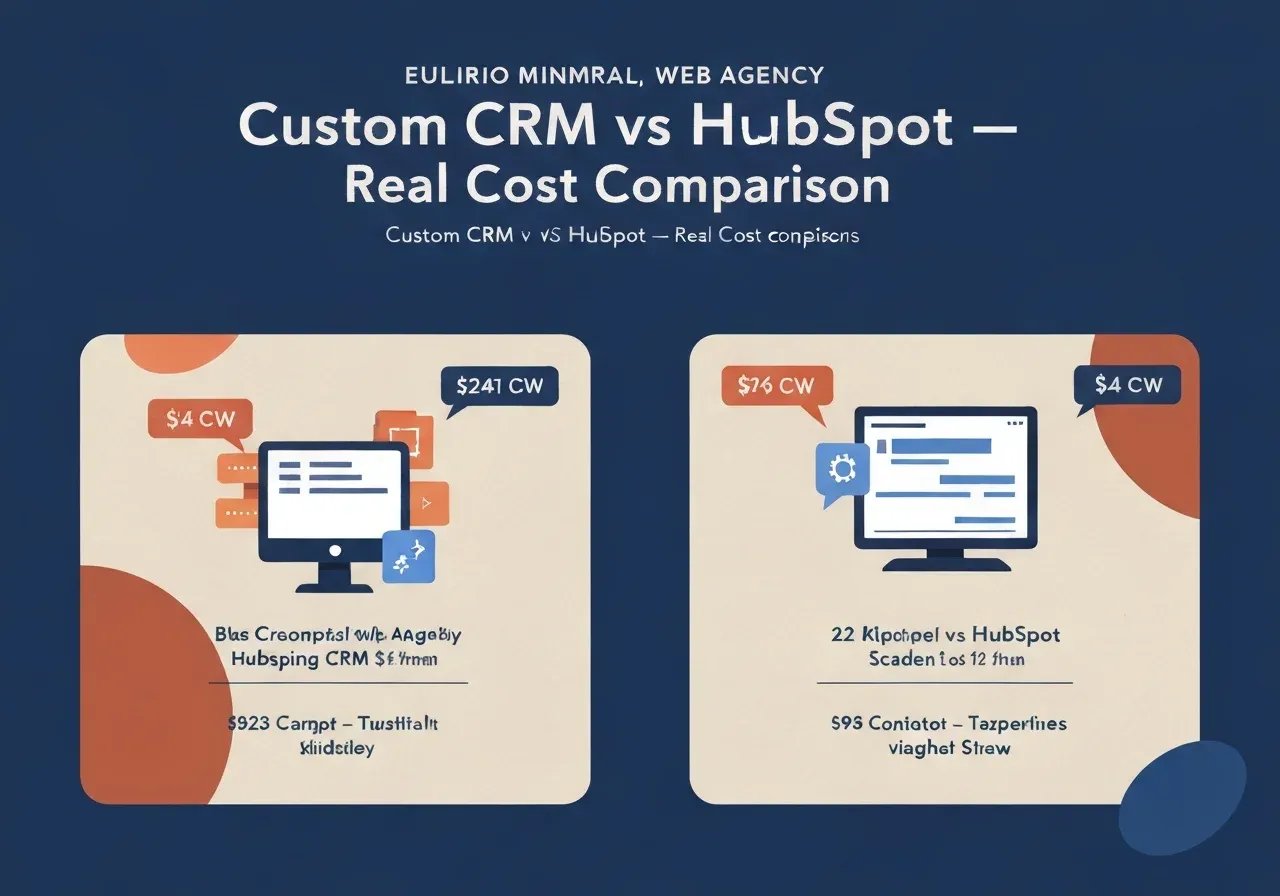
HubSpot is not a bad product. But it is priced per user and built around a US sales playbook, and that matters if you are a team of 5–20 people in the Baltics or the Nordics with a sales process that does not fit the template.
The arithmetic
HubSpot lists Sales Hub Professional at $90 per seat per month with annual billing, plus a required one-time Professional Onboarding fee of $1,500 (HubSpot pricing page, accessed November 2026; check the current price before you decide). For five users:
- $90 × 5 × 12 = $5,400 per year
- $16,200 over three years, plus the $1,500 onboarding fee
- Growing from five to ten users roughly doubles the bill
What HubSpot and Salesforce do well
A lot. Pipeline, deal tracking, e-mail sequences, contact registry and reports all work from day one, in one place, with no architecture to think about and no code to write. Salesforce adds deeper integrations and more granular reporting. With a sales team of 50 or more and a large implementation budget, it is a logical choice. For most small and mid-sized teams, it is not the situation.
Where they fall short for small and mid-sized teams
- Price grows with users. Every added seat raises the bill automatically.
- The data is there, but not really yours. You can export CSV, but deal history, activity logs and e-mail threads are in a format that mostly works inside HubSpot. Moving to another system later is a project, not an import.
- Your process adapts to them. Integration with local accounting systems such as Moneo, 1C or Jumis is not out of the box. Specific approval steps, legal documents and regional fields need workarounds or paid add-ons.
Three-year comparison
| HubSpot Sales Hub Pro | Custom CRM | |
|---|---|---|
| Per year (5 users) | $5,400 plus $1,500 one-off onboarding | no per-seat fee after the build |
| Over 3 years | about $17,700 | €12,000–€18,000 including support |
| Data ownership | No | Yes |
| Integration with local systems | Complex | Built in |
| Vendor lock-in | High | None |
HubSpot figures are in US dollars and the custom build in euros; they are not converted, so treat the comparison as an order of magnitude.
In our projects a custom CRM costs €8,000–€15,000 to build, depending on scope, plus €1,500–€3,000 a year for support and development (the studio’s own experience, not a market benchmark). The break-even point is around two years. After that each year saves roughly €4,000–€5,000, and all the data stays with you.
When a custom CRM is the wrong choice
There are cases where we would recommend HubSpot ourselves.
If your team has fewer than three people, a custom CRM is not justified; a free or low-cost off-the-shelf plan is enough. If you are only starting to structure your sales and it is not clear what the process will look like in a year, work with a ready-made tool first, learn what you need, then decide. A custom CRM is an investment that pays back after about two years. It makes sense when the process is clear, the team is above five people, and you have a three-year plan.
What a proper custom CRM includes
It is not an empty template. The core: a contact and company registry, a deal pipeline with statuses that follow your process, an activity log, document linking, user roles and access rights, and reports by your criteria. Where needed: integration with Moneo, 1C or Jumis accounting, e-mail sent from the system, SMS notifications, and a link to your e-commerce platform. It runs on your server or your cloud account. Your code, your data.
For one concrete integration pattern, see how to send web-form leads into any CRM automatically.
We start with a conversation, not an offer
If you pay for HubSpot now and something does not work, or you want to know whether a custom CRM is the logical next step, the first conversation covers requirements and your real numbers. If HubSpot turns out to be better for you, we will say so.
Discuss your CRM architecture with us
Sources
- HubSpot, Sales Hub pricing, accessed November 2026